

2025 Nobel Prize winner Omar Yaghi
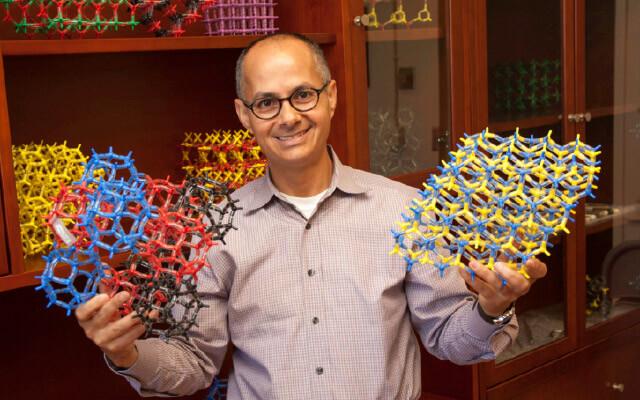
“My journey began far from any laboratory,” 2025 Nobel Prize winner Omar Yaghi says. “Hardship was everywhere. My chances for success were slim except for the surprising ways nature reveals itself and helps us overcome.” In his award speech, Yaghi recounts how his entire family, including ten children, lived as refugees in Amman, Jordan, sharing space with their family’s livestock in a one room home without electricity or running water. At ten, he first encountered pictures of molecules in his school library: “Their beauty and mystery captivated me. And when I learned that they are the building blocks of everything living and non-living, they ignited my passion for chemistry and I was hooked forever. It became my escape, my direction, and my life.”
Yaghi goes on to tell of his life in the desert, collecting water issued by the government once every week or two, desperately filling any container he could find. This experience, he believes, acted as a catalyst for his groundbreaking discovery. He explains:
Many years later, while studying how MOFs take and release water, I recognized something revolutionary in what seemed like an ordinary behavior. I saw how this MOF can pull water from desert air and turn it into clean drinking water. It echoed the rhythm of my childhood, yet now offered a solution to the very hardship we had once endured. I often wonder whether I would have recognized that pattern of data had I not lived it first.
As he explains elsewhere, his initial decision to study chemistry was not a calling to save the world, so much as a call toward beauty. His lived experience of not having enough water was something like a subconscious map toward discovery.
§
Our minds make meaning in fascinating ways. Poets express the inarticulable by putting together images, sounds, or metaphors in surprising ways, creating something larger than the sum of its parts. David Epstein, in Range, describes how humans—scientists, technology experts, artists, and others—make new developments through analogical thinking, with distant analogies proving to be exceptionally useful tools when solving complex problems.
We have the enormous privilege in our Core classes of looking at a small part of the universe with students. Our students come from all over the globe, have encountered all kinds of hardships and privileges, and are each made in the image of God. Our work as instructors allows us to help them see the beauty and mystery of the world through our own disciplinary lenses.
We also have the opportunity, as Yaghi recognizes in his speech, of working together. Yahgi calls for “a more stable, more abundant, and more just” world to pass on to the next generation. His scientific discoveries are tied to lived, human feelings, and to political and historical realities. He sees MOFs as metaphors for humanity’s potential to come together for a greater good.
Yaghi’s story reminds us that our work as Core instructors is to see value and potential in our students, just as we see the beauty of our own subject matter, and to introduce them to a part of the world that might ignite their imaginations and offer them tools for living.
Our work is also to see the value of the Core outside of our own framed disciplines. As humanities scholar Kathleen Fitzpatrick says, “The future of the university requires regrounding the institution in a mode of what I refer to as ‘generous thinking,’ focusing its research and its pedagogical practices around building community and solidarity both on campus and across the campus borders.” Listening to one another across programs allows us to assemble a bigger picture for our students of the learning they are creating. It also helps us acknowledge that we need each other, that a university degree should be about more than individual profit, that it should be aimed toward higher ideals and character development, and that our efforts should be embedded within the needs and work of our communities.
Here at the end of the semester, we have two opportunities for cross-disciplinary collaboration amongst Core faculty. The first is our Core book club, open to any Core instructor on a first come first served basis. We will discuss The Power of Language: How the Codes We Use to Think, Speak, and Live Transform our Minds by psycholinguist, cognitive scientist, and psychologist Viorica Marian. Yaghi’s father encouraged him to learn other languages beyond his native Arabic, which opened new metaphorical modes of thinking to him; Marian’s book explains more about how this works.
The second is our Core Curriculum Fellows program, open to a select ten faculty who teach any Core class. Our Fellows will receive $1,000 each and will listen, collaborate, and ultimately articulate how students benefit from a Core education. This year’s topic is “human flourishing.”
Even if you can’t join one of these groups, there are many ways to pause and appreciate the privilege that it is to be a part of something as transformational and interconnected as Baylor’s Core curriculum. Thank you for the work you do caring for students and connecting them to the wonder of your disciplines.